Metroid Prime (NGC)

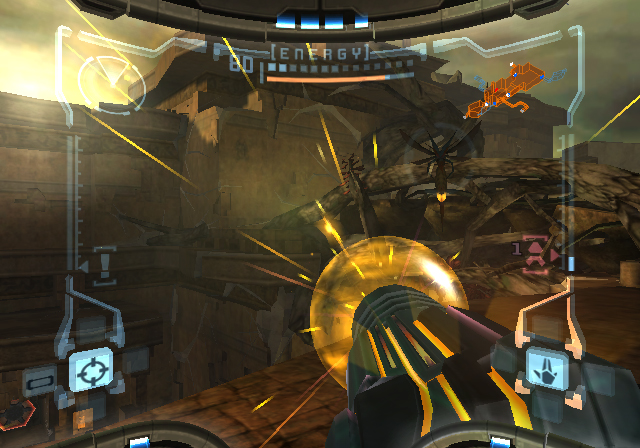
Let's get one thing straight before we even start. Metroid Prime doesn't beat Super Metroid. With that out of the way, let's start properly.
Metroid Prime is one of the last big Nintendo-games to make the jump into 3D (only Kid Icarus remains). It is also the hardest jump, but for entirely different reasons than one might think. The game starts off somewhere between Metroid (NES) and Metroid II: Return of Samus (GB). A few Pirate ships have escaped the destruction of their first Zebesian hideout by main character Samus Aran and have settled on Tallon IV where they are regrouping and doing research for more potent weapons. Things are getting out of hand though and ironically Aran is drawn towards the planet by a distress beacon send out by one of the orbiting Pirate-ships.
The game starts on the ship and just like in Super Metroid it serves as a hit and run section to introduce the game. As Samus jumps out of her ship utilising her signature yet not usable somersault-jump, the familiar start-fanfare echoes out of the speakers and you're off! Well somewhat anyway, the game has adopted a first-person view making things feel a little bit out of place initially. Things quickly pick up as you get the hang of the controls (which basically boils down to being able to R-lock, meaning looking around with R and 'taking over the aim' with L) and anyone with a master's degree in Ocarina of Time should feel right at home with the lock function.
After the introduction part, things move on to the planet itself. There the usual Metroid-pace is picked up almost flawlessly. as the "explore area, get power-up, explore bigger area" formula is used to an almost religious degree. It does seem to be making sure however, that whenever a boss is killed you do get a power-up. Thus it becomes more of a boss-hunt instead of exploration, while accidentally bumping into a boss. This is somewhat countermeasured by the inclusion of the Artifact-lock upon the final area requiring more exploration of the planet. Which ironically feels more like a Rare-developed measure to lengthen the game than the true-to-the-series significance it should have had. Also at some points the backtracking is severely overdone. The Space Boots for example are put at an extremity in relation to the previous power-up, even capable of frustrating Metroid-junkies going for speed-records.
There is however one flaw that renders the previous problems non-existent. As I said earlier, Prime doesn't topple Super. The reasoning behind this is that Samus is severely restricted in the movement department. Taking out the somersault- and walljump was more or less a given with the first-person view, but taking out things like the Spring Ball, the Space Jump (replacing it with a watered down Castlevania-like double jump) and the Charge Boost while making the Grapple Beam available only in the final part of the game and making Morph Ball & Bomb points too obvious, makes Samus feel like an old lady. The Boost- and Spider Ball might compensate but their possibilities of any real use are limited (the Boost Ball does get the better cut of the two tough, yet could have been better it had not been for the weapon-coded doors). Compare a fully tooled up Samus out of Super Metroid to the one in Metroid Prime and it becomes painfully apparent that Prime's Samus is focusing upon arsenal rather than movement.
As such the game loses a lot of the hardcore charm that came with it; gamers who breathed Metroid could do amazing feats in Super. The game provided the tools and Zebes was your playground. Prime doesn't do that, instead movement power-ups available do little to enhance the overal way of transportation across the planet, effectively taking some joy out of the backtracking. Why the Grapple Beam was positioned at the end of the game is still a mystery, although a very small amount of somewhat uninteresting grapple points hint at simply not having time to implement it any further.
Of course this all sounds rather severe, but it are just some purity problems. It seems rather contradictory, but I can't congratulate Retro Studios enough on producing one of the finest games on Earth. Graphically and design-wise Prime has an absurd amount of detail. While the obvious remark might be "but the textures aren't sharp up close", the sheer design of the various rooms, areas and corridors simply defy logic. On an architectural level nothing really comes close. Playing Prime it was as if I was really 'somewhere'. Afterwards I returned to HALO and while that game might to some degree have better textures (next to being a different game), all the levels felt like I were travelling inside gigantic sterile LEGO-buildings, the outside levels just being plain dull. The sheer atmosphere that oozes out of Prime by simple asymmetry design and little odd irregularities is just fantastic.
The feeling is enhanced tremendously by use of the visors, while heavily dependent on some boss-gimmickry, its implementation is one of the little bits that will be ripped out of Prime to be used in any subsequent developed game. The only complaint here is that the amount of 'useless, yet informing' environmental scanpoints is significantly reduced after the Chozo Ruins area leaving you to wonder what could have been if more time had been available for the extras. That said, reading about yourself while scanning enemy-computers is guaranteed to make you smile.
On the audio level, Kenji Yamamoto returns for duty after Super. Tracks are again very good but seem to lack clear definable melodies. Although the second upbeat Phendrana Drifts theme and Magmoor Caverns will get stuck into your head, surprisingly little else of the soundtrack will achieve that. While true in the spirit of "Hip" Tanaka's original Metroid-soundtrack, one can't help but wonder why there aren't equivalents to Super's Crateria, Brinstar and Maridia themes. Still they get the job more than done and the new 'direction' into the more 'technical style' is to be applauded.
The gameplay is still as addicting as it ever was, the sheer unique Metroid-taste might be softened somewhat to cater to a broader audience and to facilitate the jump into 3D, but it's entirely worth it. It's one of the first true classics to emerge out of the next-gen consoles, that actually evolves gaming a bit. The control-scheme might be the bane of a two-stick FPS-addict, but anybody not willing to learn new control-schemes should be excluded from the gaming community as it defies the simple reasoning that games could and should be different.
In short Retro Studios has produced an epic masterpiece, which is literally what it says on the tin; Metroid 3D. Those expecting Super Metroid 3D however, should wait for the second round, as it is clear Retro Studios is just getting warmed up by proving that the impossible can be done.
As a side note: the PAL version is significantly easier than its NTSC counterpart. Item appearance has more than doubled (walking out of a wave of Scarabs with more energy than you dived in with) and some boss-patterns are weakened. Whoever at Nintendo decided to call this version 'harder' was obviously not really into the game at all. Phazon Mines was almost a walk in the park with the amount of items left behind. It doesn't prove entirely problematic though, as the NTSC version was kind of too hard at places and the gameplay remains intact, but why Nintendo is promoting it as being harder is beyond me.